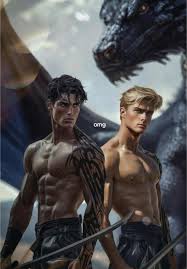
Here's something I can't unsee.
In almost every romantic triangle in Western literature, the transgressive lover has dark hair. The legitimate one is golden.
Lancelot: dark. Arthur: golden.
Tristan: dark. King Mark: fair.
Heathcliff: dark. Edgar Linton: blonde.
Rhysand: dark. Tamlin: golden.
Riven: dark. Caelan: golden.
I didn't plan this. I wrote what felt right and only later realised that “what felt right” was a pattern eight centuries old. Which is unsettling, and also probably the point. The grammar of desire is older than any of us, and it teaches itself through every story we've ever loved without announcing itself as curriculum.
The oldest love triangle in the room
The Arthurian legend is where the template crystallises. Arthur is the legitimate king — chosen, crowned, the principle of order and duty. Lancelot is the greatest knight who ever lived and also the man whose love brings Camelot down. The story doesn't condemn him. It mourns him. It mourns Guinevere. It mourns the fact that the truest love is the one that destroys the kingdom, and it can't decide whether that's tragedy or inevitability.
Malory presents both things as completely true and irreconcilable. Lancelot is the best of them. Lancelot is the ruin of them. Both at once. No resolution offered.
Tristan and Iseult is the satellite myth that takes this structure and strips it down to its essentials. Denis de Rougemont, in Love in the Western World, argued that the Tristan myth isn't really a love story at all. It's a story about the need for obstacles. That Tristan doesn't actually want Iseult — he wants the longing. The love potion isn't the cause of their love but the excuse for it: a way of saying we have no choice when the truth is that the impossibility of the love is precisely what makes it feel absolute.
King Mark isn't a villain. That's crucial. He's the principle of legitimate order, the person Iseult is structurally bound to, whose existence makes the other love feel both transgressive and inevitable. If he were monstrous, Iseult's choice would be easy. The structure requires him to be reasonable, even sympathetic. The obstacle has to be real or the transgression costs nothing.
De Rougemont's central claim: happy love has no history. Western romantic love, he argues, is structurally death-seeking. The obstacle is not incidental to the love story but constitutive of it. Consummated love would end the narrative. The distance is the point.
A Court of Tristan and Iseult
Which brings me to Sarah J. Maas and A Court of Mist and Fury.
I loved ACOMAF. Loved it in the way you love something that lands on a bruise you didn't know you had. And I didn't understand why until I started pulling this thread.
The structure is Tristan, almost exactly. Feyre opens the book already bound to Tamlin — the marriage made, the obligation established, the legitimate claim in place. Tamlin is King Mark in every functional detail. Not cruel in the way villains are cruel. Possessive, suffocating, well-intentioned, and structurally in the way. His love is real and it is the wrong kind of love and the story needs him to be both.
Rhysand is Tristan. The darkness, the reputation for cruelty that masks something more complicated, the bond that exists before either of them is willing to name it. And the mating bond — the mystical compulsion — is the love potion. Not the cause of the love but the alibi for it. The thing that lets them both say this isn't a choice while it very obviously is.
De Rougemont would recognise it instantly.
The forest of Velaris
In the Tristan legend there's a sustained sequence where the lovers flee into the forest of Morois and live outside society — outside the court, outside obligation, in a liminal space that belongs to neither of them. The impossible love becomes temporarily possible. It's the time outside of time.
Velaris is the forest of Morois. The hidden city, the found family, the world beneath the world that Tamlin doesn't know exists. Feyre and Rhysand exist there outside their respective obligations — she is technically Tamlin's, he is technically her captor — and the city becomes the space where the real relationship forms, protected from the daylight world that would forbid it.
Even the concealment maps directly. Rhysand maintains the performance of cruelty for the outside world, the same way Tristan maintains the performance of loyal knight, while something entirely different happens in private.
Where Maas breaks the myth
Here's where it gets interesting. The Tristan myth, as de Rougemont reads it, is death-seeking. The love can only be fulfilled in dissolution — Tristan dies, Iseult dies over his body. The obstacle is never removed. It's transcended through ending. Happy love has no history, and the myth proves it by making sure the love never gets to be happy.
Maas refuses this. ACOMAF ends not in dissolution but in consummation and survival. The mating bond accepted, Tamlin's claim relinquished, the lovers in the daylight together. Which is exactly what de Rougemont says the troubadour tradition structurally cannot do.
The cynical reading is that Maas takes the Tristan architecture because it generates enormous romantic tension and then defuses it because the genre requires a happy ending. The more generous reading — and the one I believe — is that she's rewriting the myth. Taking the troubadour structure that was always implicitly death-seeking and asking what happens if the woman survives and chooses and gets to keep the thing she chose.
That's a feminist intervention in a very old story, whether Maas intended it as one or not.
The question she didn't ask
But there's a question Maas sidesteps. The one de Rougemont says is fundamental: can the love survive becoming possible?
She avoids it by making the obstacle external and removable. Tamlin is the problem. Once Tamlin is no longer the problem, the love gets to be straightforwardly happy. The distance closes and the story ends, and we never find out whether Feyre and Rhysand's love can bear its own fulfilment because the book doesn't ask.
This isn't a criticism. It's a genre observation. Romantasy does this. It has to. The reader comes for the tension and the yearning and the slow burn and the finally — and the finally has to land like a cathedral bell or the contract is broken.
But it means the deepest question the Tristan myth asks — whether love that was sharpened by impossibility can survive in ordinary air — remains unanswered.
I'm writing Anamnesis partly to answer it.
The troubadour's disguise
There's one more thing worth saying about romantasy and it's something I keep coming back to.
The troubadour poems looked like simple love songs. That was the strategy. The mystical architecture was invisible to anyone who wasn't looking for it. The Cathars could pass them around in plain sight because all the uninitiated saw was a man yearning for a woman.
Romantasy works the same way. The surface is accessible — magical academy, love triangle, beautiful dangerous men making terrible choices, the heroine discovering her power. It's shelved in fantasy romance. It has covers with swords and shadows and the occasional shirtless torso. Nobody expects Nietzsche.
But underneath? De Rougemont's entire thesis lives in ACOMAF whether Maas put it there consciously or not. The question of whether love requires obstacles. The forest outside society. The potion that isn't really about compulsion. The golden one and the shadow and the woman caught between them, which is a story we've been telling for eight hundred years in the same colours every time.
People underestimate this genre. I think that's a feature, not a bug.
The best disguise for something profound has always been something beautiful.
The troubadours knew it. Maas knows it, at some level. I'm counting on it.
The Anamnesis Trilogy is a dark romantasy about power, memory, and the architecture of the self. Book One is coming soon. Join the newsletter for early excerpts and craft notes.
Join the Newsletter